 Science fan, yay!
Grumble grumble, not real science, etc
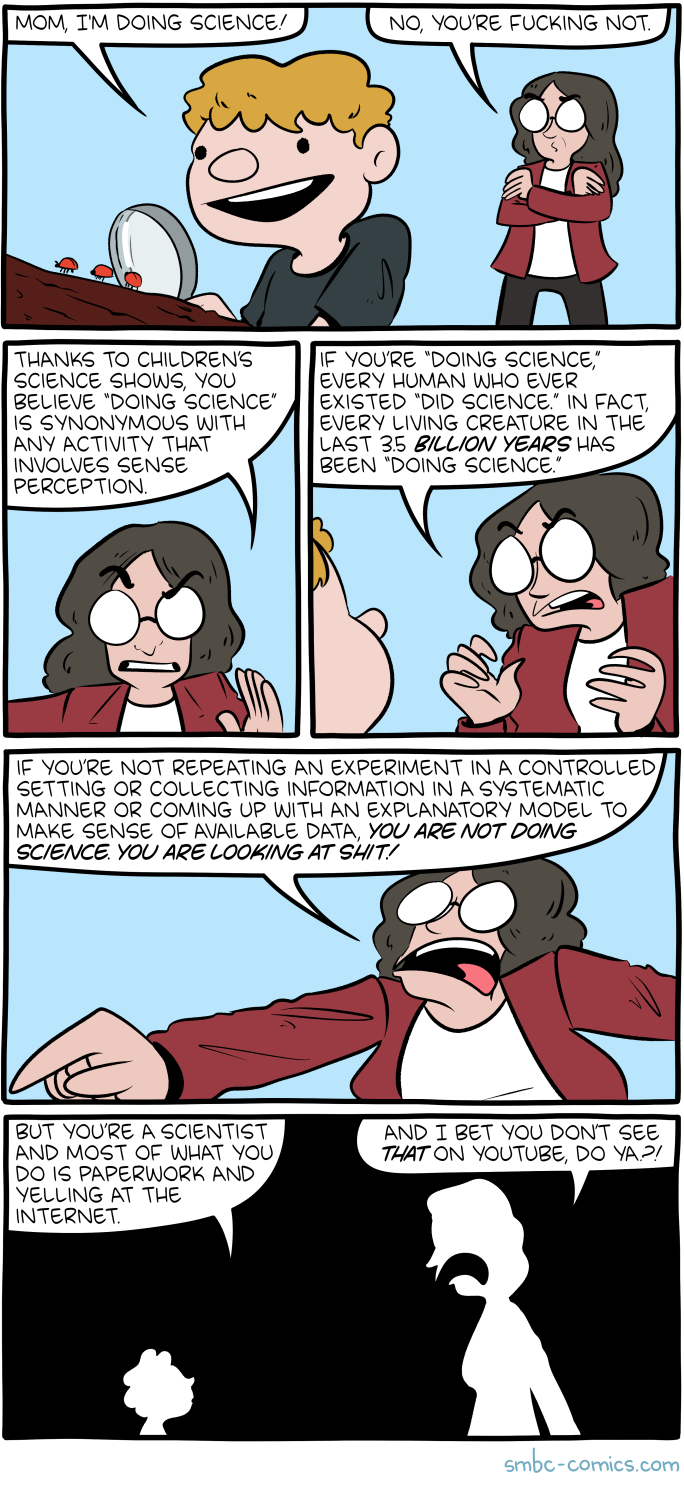
 Invisible Wizard - 13th Level Scrote, Thu 23 Dec 2021, 20:54,
Reply)
Yeah. Science is, like, really elitist though.
(
Prufrock Lucifer, son of the morning!, Thu 23 Dec 2021, 22:10,
Reply)
Yeah, this is why I'm an engineer by trade, not a scientist
- I personally closely know someone who was denied their biochemistry PhD because their findings undermined the published work of the head of their department, at a top tier British uni.
Thankfully, the science has since moved on and the truth (the science anyway, not the academic obstruction) is now out.
My guy works as a teacher, and is pretty happy with that these days.
(
Invisible Wizard - 13th Level Scrote, Thu 23 Dec 2021, 23:16,
Reply)
don't agree with those criteria.
I'd say science is broadly a label for any attempt to get more knowledge. However some science (or it's results) is a lot more useful than other science, and that's generally that which employs a systematic method, i.e., the scientific method.
Still, burning ants teaches the kid a surprising amount of things:
*how light focuses through a parabola, and the distance of that focal point. later when they learn about the eye or cameras they'll have a visual model as a reference
*how it concentrates the intensity of that light, and that small diameter of sunlight actually has enough heat to burn things. This demonstrates how much power the sun puts out compared to other sources of light
*about the mortal tolerance capacity of ants to heat, and their combustibility
*about the smell of their chitin when cooked, which can give clues to its composition
*about ant behaviour and path selection, and their behavioural response when subjected to heat, or to that of other colony members when barbecued in close proximity, such as threat response, increased speed and in some cases taking the charred bodies back to the nest
*and perhaps an introduction to the ethics of animal testing and intervention in science, should the kid choose to contemplate it
So I reckon it's one of the better science experiments a kid could do
(
 cumquat may will not be commenting further on the allegations, Thu 23 Dec 2021, 23:24,
Reply)
Royal Institute Christmas Lecture coming soon!
best thing about any year
(
 Woodkovsky ☹️➝🚻➝🚽➝😣➝💩➝🧻➝😁, Thu 23 Dec 2021, 23:47,
Reply)