 Sorry my brain is on the fritz again
TODAY'S TALK IS ON GENTLEMEN
The term gentleman (from Latin genitalismaximushomo meaning man who acts like he has a big cock cognate with the French word gentilhomme and the Italian gentil uomo or gentiluomo) in its original and strict signification denoted a man of good family the Latin generosus (its invariable translation in English-Latin documents).
William Harrison says 'gentlemen be those whom their race and blood or at the least their virtuse do make noble and known and stuff'. A gentleman was in his time usually expected to have a coat of arms this was not a coat of arms as we know it today but a coat fashioned from chimpanzee arms. A gentleman would use the little hands to carry around his worldly posessions it wasn't until around 1600 that pockets were invented.
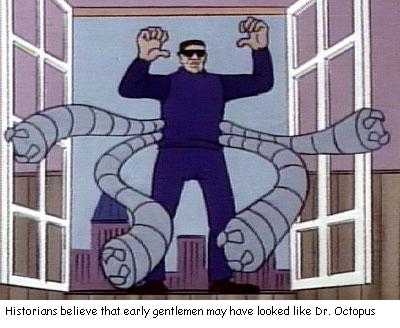
Shakespeare himself was demonstrated by the grant of his coat of arms to be no 'vagabond' but a gentleman. The inseparability of arms and gentility is shown by two of his characters:
Petruchio: I swear I'll cuff you if you strike again.
Katharine: So may you lose your arms: If you strike me you are no gentleman;
And if no gentleman why then no arms.
Petruchio: You can take my life you can take my freedom but you'll never have my monkey jacket
(The taming of the schrew. Act II Scene i.)
Although the monkey coat was highly important for early gentelmen in later years a gentleman was defined by his actions rather than social status. Social decorum ettiquette and manners all became part of being a gentleman.
Social Decorum was first invented by Lord Chesterfield in 1725 in an attempt to unify several different white papers which had been submitted on manners and etiquette. Lord Chesterfield was forced later to reduce his paper on conduct due to constant changes in the rules governing social behaviour.
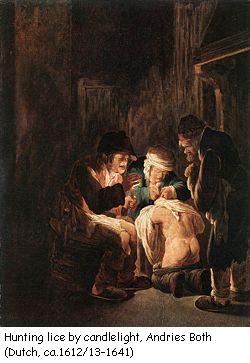
Unfortunately for Lord Chesterfield he was hoisted by his own petard he'd failed to keep up with the rules of etiquette spending too much time in the house of lords and not enough time keeping his elbows of his well polished dining table. In 1732 Chesterfield demanded several of his guests removed their underpants and prepared to be inspected for lice. While this would have been socially acceptable in 1725 it was considered at the time to be the biggest social faux pas in history.
Chesterfield's guests were governed by the rules of social etiquette and were forced to go along with this request rather than speak out to Lord Chesterfield. One guest even posed for a commisioned picture of the act (See below) crouching with his buttocks exposed for 6 hours. The embarassment was too much for Chesterfield and he never recovered. It is recorded that on his deathbed his last words were 'damn and blast those stupid lice'
It was after this terrible incident that the Emperor of Britain decided that the strict rules of social etiquette should no longer apply to gentlemen and they should be judged to be a gentlemen based on social standards of the time rather than rules and social status.
In 1731 the act of being a gentlemen was so popular that The Gentleman's Magazine was founded in London by Edward cave . The original complete title was The Gentleman's Magazine: or Trader's monthly intelligencer. Cave's innovation was to create a monthly digest of news and commentary on any topic the educated public might be interested in from commodity prices to Latin poetry. 'storehouse') for a periodical.
The earliest eddition in existence today is the 1755 issue where a competition was held for single men around the country to draw a picture of what a naked lady might look like.
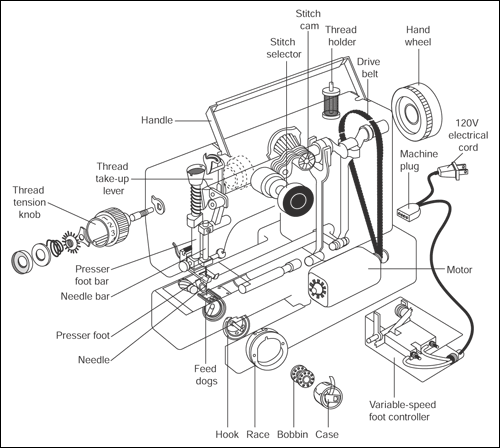
The compeition was judged by a man called Burt Ringledinc The Third who said he had seen his wife naked once. Charles Weisenthal won this competition with the entry below which later became the first blueprint for a modern sewing machine. Some historians today believe that Charles Weisenthal wasn't that close with his illustration and question the authenicaty of Mr. Ringledinc's claim that he had seen his wife naked.
(The term gentleman (from Latin genitalismaximushomo meaning man who acts like he has a big cock cognate with the French word gentilhomme and the Italian gentil uomo or gentiluomo) in its original and strict signification denoted a man of good family the Latin generosus (its invariable translation in English-Latin documents).
William Harrison says 'gentlemen be those whom their race and blood or at the least their virtuse do make noble and known and stuff'. A gentleman was in his time usually expected to have a coat of arms this was not a coat of arms as we know it today but a coat fashioned from chimpanzee arms. A gentleman would use the little hands to carry around his worldly posessions it wasn't until around 1600 that pockets were invented.
Shakespeare himself was demonstrated by the grant of his coat of arms to be no 'vagabond' but a gentleman. The inseparability of arms and gentility is shown by two of his characters:
Petruchio: I swear I'll cuff you if you strike again.
Katharine: So may you lose your arms: If you strike me you are no gentleman;
And if no gentleman why then no arms.
Petruchio: You can take my life you can take my freedom but you'll never have my monkey jacket
(The taming of the schrew. Act II Scene i.)
Although the monkey coat was highly important for early gentelmen in later years a gentleman was defined by his actions rather than social status. Social decorum ettiquette and manners all became part of being a gentleman.
Social Decorum was first invented by Lord Chesterfield in 1725 in an attempt to unify several different white papers which had been submitted on manners and etiquette. Lord Chesterfield was forced later to reduce his paper on conduct due to constant changes in the rules governing social behaviour.
Unfortunately for Lord Chesterfield he was hoisted by his own petard he'd failed to keep up with the rules of etiquette spending too much time in the house of lords and not enough time keeping his elbows of his well polished dining table. In 1732 Chesterfield demanded several of his guests removed their underpants and prepared to be inspected for lice. While this would have been socially acceptable in 1725 it was considered at the time to be the biggest social faux pas in history.
Chesterfield's guests were governed by the rules of social etiquette and were forced to go along with this request rather than speak out to Lord Chesterfield. One guest even posed for a commisioned picture of the act (See below) crouching with his buttocks exposed for 6 hours. The embarassment was too much for Chesterfield and he never recovered. It is recorded that on his deathbed his last words were 'damn and blast those stupid lice'
It was after this terrible incident that the Emperor of Britain decided that the strict rules of social etiquette should no longer apply to gentlemen and they should be judged to be a gentlemen based on social standards of the time rather than rules and social status.
In 1731 the act of being a gentlemen was so popular that The Gentleman's Magazine was founded in London by Edward cave . The original complete title was The Gentleman's Magazine: or Trader's monthly intelligencer. Cave's innovation was to create a monthly digest of news and commentary on any topic the educated public might be interested in from commodity prices to Latin poetry. 'storehouse') for a periodical.
The earliest eddition in existence today is the 1755 issue where a competition was held for single men around the country to draw a picture of what a naked lady might look like.
The compeition was judged by a man called Burt Ringledinc The Third who said he had seen his wife naked once. Charles Weisenthal won this competition with the entry below which later became the first blueprint for a modern sewing machine. Some historians today believe that Charles Weisenthal wasn't that close with his illustration and question the authenicaty of Mr. Ringledinc's claim that he had seen his wife naked.
 mrbongo sweating like a formicophiliac on I'm a celebrity,
Mon 3 Sep 2007, 0:09,
archived)
But we love him for it so.
mrbongo sweating like a formicophiliac on I'm a celebrity,
Mon 3 Sep 2007, 0:09,
archived)
But we love him for it so.:)
( Spider Fucking Riviera got stiches for a knife wound for the first time,
Mon 3 Sep 2007, 0:13,
archived)
Spider Fucking Riviera got stiches for a knife wound for the first time,
Mon 3 Sep 2007, 0:13,
archived)
 ahhaa, I do like you.
 (|D[ekionplexis B3ta.com: fictional child porn is OK,
Mon 3 Sep 2007, 0:22,
archived)
Everybody wants him, and he knows it.
(|D[ekionplexis B3ta.com: fictional child porn is OK,
Mon 3 Sep 2007, 0:22,
archived)
Everybody wants him, and he knows it. Tahkcalb ω∞ for sigs,
Mon 3 Sep 2007, 0:27,
archived)
So seductive. (|D[ekionplexis B3ta.com: fictional child porn is OK,
Mon 3 Sep 2007, 0:38,
archived)
Tahkcalb ω∞ for sigs,
Mon 3 Sep 2007, 0:27,
archived)
So seductive. (|D[ekionplexis B3ta.com: fictional child porn is OK,
Mon 3 Sep 2007, 0:38,
archived)
 you heard mrbongo sweating like a formicophiliac on I'm a celebrity,
Mon 3 Sep 2007, 0:15,
archived)
you heard mrbongo sweating like a formicophiliac on I'm a celebrity,
Mon 3 Sep 2007, 0:15,
archived)
 Oh god
that scares me
( mrbongo sweating like a formicophiliac on I'm a celebrity,
Mon 3 Sep 2007, 0:18,
archived)
you changed itwas the other one you?
( mrbongo sweating like a formicophiliac on I'm a celebrity,
Mon 3 Sep 2007, 0:19,
archived)
i realized it was not quite capturing the intended effect of my replyand no it's not me. i should be so lucky as to have maurice dean wint's stunning visage.
( AgentMuu hentai coordination,
Mon 3 Sep 2007, 0:21,
archived)
i just watched the non-adventures of disappointment ostrich.
AgentMuu hentai coordination,
Mon 3 Sep 2007, 0:21,
archived)
i just watched the non-adventures of disappointment ostrich.well done sir. well done indeed.
( AgentMuu hentai coordination,
Mon 3 Sep 2007, 0:26,
archived)
should have his own site as soon as I get my lights fixedand build this new pc
( mrbongo sweating like a formicophiliac on I'm a celebrity,
Mon 3 Sep 2007, 0:36,
archived)
SoYou think you could out-clever us French folk with your silly knees-bent running about advancing behaviour?
I wave my private parts at your auntie you cheesy lot of second-hand electric donkey-bottom biters.

(I wave my private parts at your auntie you cheesy lot of second-hand electric donkey-bottom biters.
 Flowerpot No longer has the vapours thanks to DTH,
Mon 3 Sep 2007, 0:36,
archived)
very informative and interesting
Flowerpot No longer has the vapours thanks to DTH,
Mon 3 Sep 2007, 0:36,
archived)
very informative and interestingyou are clearly very well educated
( Mousing,
Mon 3 Sep 2007, 0:15,
archived)
Yay!
Mousing,
Mon 3 Sep 2007, 0:15,
archived)
Yay!I learn so much from you. Not least that you are ever-so-slightly bonkers.
I hope you do laydees soon. In a Harry Enfield stylee :)
Edit: Oops I see you've already been called bonkers. Well that adds weight to my comment.

(I hope you do laydees soon. In a Harry Enfield stylee :)
Edit: Oops I see you've already been called bonkers. Well that adds weight to my comment.
Flowerpot No longer has the vapours thanks to DTH,
Mon 3 Sep 2007, 0:15,
archived)

 It's
It'slike Milligan is amoung us.
( TheSundaeLunch I'm a fucking shrub, alright?,
Mon 3 Sep 2007, 0:20,
archived)
Will there be a quiz ?
TheSundaeLunch I'm a fucking shrub, alright?,
Mon 3 Sep 2007, 0:20,
archived)
Will there be a quiz ?If so . . . I will need a few moments to digest . . . this . . .
( Valin I changed glasses while I wasn't looking,
Mon 3 Sep 2007, 0:25,
archived)
OKQuestion 1: who was the father of Burt Ringledinc The Third's children?
( mrbongo sweating like a formicophiliac on I'm a celebrity,
Mon 3 Sep 2007, 0:28,
archived)
HaIt was his wife barry
( mrbongo sweating like a formicophiliac on I'm a celebrity,
Mon 3 Sep 2007, 0:39,
archived)
Now youtell me . . . I shoulda knowed that . . .
( Valin I changed glasses while I wasn't looking,
Mon 3 Sep 2007, 0:47,
archived)
That would betheir grandfather.
( Valin I changed glasses while I wasn't looking,
Mon 3 Sep 2007, 0:39,
archived)
 I AM A GENTLE GENTLEMAN.
EXCEPT WHEN I'M REALLY REALLY DRUNK, THEN ALL BETS ARE OFF
Rapitinui get in the cage and I'll give you a treat,
Mon 3 Sep 2007, 0:29,
archived)

 Thank you.
I hope that others attempt to emulate your budding lunacy. Practice it and hone your craft and you'll go far- it's done well by John Cleese and Stephen Fry, to name two.
Very much woo!
(Very much woo!
The Resident Loon Not a demographic. Do not measure.,
Mon 3 Sep 2007, 2:00,
archived)